Decisions fit for our grandchildren
Would I still make this decision if my grandchildren were to have to live with the consequences in 30 years’ time?
Recent years have shown just how important this long-term perspective is. During the coronavirus pandemic, global supply chains were suddenly disrupted. The war in Ukraine caused energy prices to rise sharply. At the same time, heatwaves and extreme weather events are on the rise. Developments such as these have direct impacts on businesses, households and investments, and demonstrate just how important long-term thinking has become.
Sustainability under pressure
The long-term time horizon is one reason why ‘sustainability’ faces an uphill struggle. Hardly any other term divides opinion so much. For some, sustainability is indispensable for tackling long-term challenges. For others, it stands for additional bureaucracy, higher costs or ideologically driven debates. The result: it has become increasingly difficult to have an objective discussion
In fact, a certain degree of disillusionment has set in over recent years. Expectations of sustainability initiatives were, in some cases, very high, whilst at the same time companies were faced with extensive reporting obligations. The result is a backlash. There is a danger here that the discussion will be narrowed down to regulation and bureaucracy. However, the underlying challenges remain. Supply chain risks, the impacts of climate change, resource availability and geopolitical tensions do not disappear simply because there is less reporting on them.
Not merely an end in itself
This is precisely why sustainability is becoming increasingly important. Not as an end in itself, nor as a moral ideal, but as a framework for guiding long-term decisions in a complex world.
Sustainability encompasses two closely interlinked dimensions. On the one hand, it is about reducing negative impacts on the environment and society – tackling the root causes. This includes, for example, reducing greenhouse gas emissions, improving energy efficiency and using resources sparingly. On the other hand, it is about adapting to the changes that are already being felt today. This includes, for instance, adapting buildings to more frequent heatwaves, managing extreme weather events, building more resilient supply chains and ensuring a reliable energy supply.
The ability to cope with change
The second aspect, in particular, has grown in importance in recent years. The ability to cope with change, to adapt and to remain capable of taking action even under difficult conditions is often referred to as resilience. Resilience is an essential component of sustainability.
This perspective is particularly relevant for Liechtenstein. As a small, internationally interconnected business hub, the country has repeatedly had to adapt to new conditions throughout its history. Changes in energy prices, trade relations or international supply chains often have direct impacts on it's export-oriented economy. At the same time, Liechtenstein has a long tradition of innovation, entrepreneurship and long-term thinking. These qualities will continue to be crucial in successfully overcoming new challenges in the future.

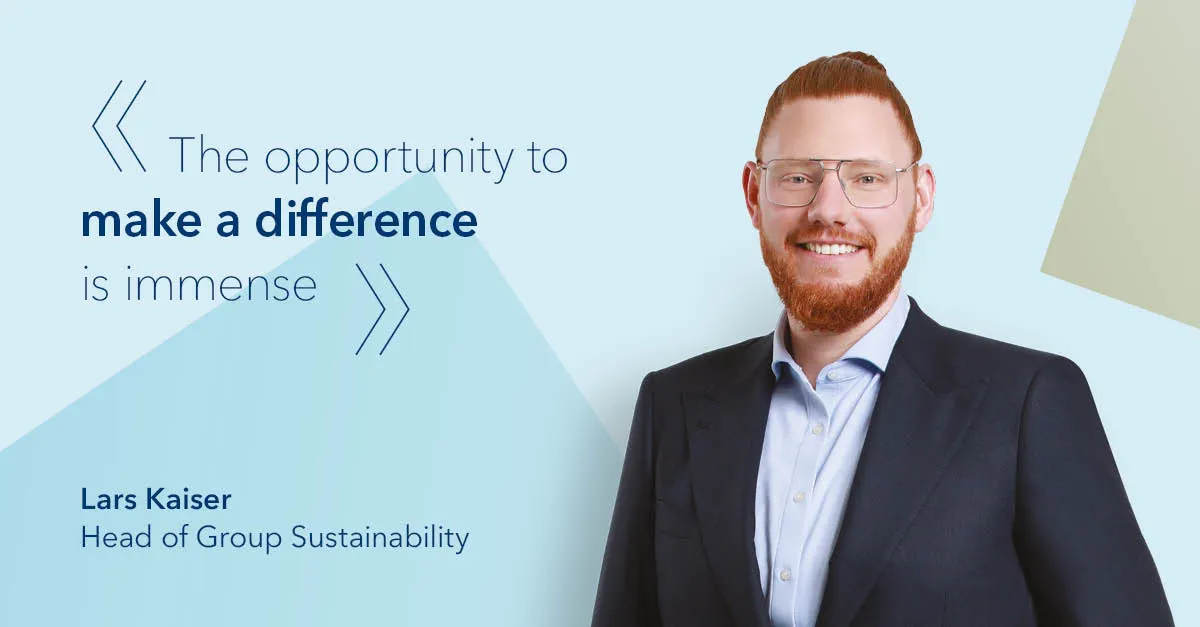
Resilience is an essential component of sustainability.
Lars Kaiser Head of Sustainability
Sustainability in practice
In recent years, many companies have critically reviewed their supply chains. Those that source key components from a single supplier face considerable risks. Whilst alternative suppliers or larger stock levels may increase costs in the short term, they can significantly improve a company’s ability to act in times of crisis. A shift in mindset from ‘just in time’ to ‘just in case’ reflects this development.
However, sustainability and economic resilience do not always go hand in hand. Additional storage capacity, alternative suppliers or investments in new technologies incur costs and can affect profitability in the short term. Sustainable business conduct does not mean that there are no conflicting objectives. The key is to weigh these up carefully and not lose sight of the long-term benefits. Those who focus exclusively on short-term optimisation run the risk of overlooking long-term risks and opportunities.
A similar shift is evident in the field of investments. Investors are increasingly interested in how companies deal with issues such as energy supply, dependence on raw materials or geopolitical risks. Such factors can influence a company’s future profitability just as much as traditional financial indicators. Geopolitical tensions, national security issues, strategic dependence on commodities and the stability of global value chains are increasingly influencing the long-term development of companies and markets.
Change brings opportunities
One example of this is rare earth elements. They are needed for the technologies that help us move away from fossil fuels – ranging from batteries and wind turbines to semiconductors. Their extraction often requires large quantities of water and chemicals. Furthermore, it produces residues and waste rock piles that must be carefully managed. At the same time, the processing of many of these commodities is concentrated in just a few countries, creating additional geopolitical dependencies.
The circular economy can address several of these challenges simultaneously. Through recycling and a more efficient use of materials, resources are conserved and environmental impacts are reduced. At the same time, geopolitical dependencies are reduced, supply chains become more robust and security of supply is improved. This example shows that reducing negative impacts and strengthening resilience can go hand in hand.
Sustainability is also becoming increasingly important in the construction sector. For many households, home ownership represents their greatest asset. Decisions relating to construction, purchase or refurbishment have an impact spanning several decades. Energy efficiency, running costs, value retention and adaptability to changing climatic conditions are therefore coming into focus. The increasing number of hot days is already changing the demands placed on buildings. Effective shading, modern insulation or a solar panel system can help to enhance living comfort and reduce energy costs in the long term. Anyone building or renovating today is making decisions that will often have an impact for the next 30 to 50 years. Investments in line with modern building standards can help to reduce energy consumption, emissions and running costs. This increases real estate’s long-term appeal and helps it retain its value.
Long-term perspective
Despite all their differences, these examples reveal a common pattern: decisions are increasingly being made under conditions characterised by uncertainty. This is precisely why long-term perspectives are becoming increasingly important. Investments, corporate finance and real estate may appear to be distinct topics at first glance. In fact, they are linked by a common question: How can decisions be made that are both fit for our grandchildren’s future and economically viable?
This is precisely where the true meaning of sustainability lies. It is neither a short-term trend nor an isolated discipline. It is an approach that takes long-term developments into account and incorporates both opportunities and risks into decision-making, whilst also considering economic factors.
Those who adopt this perspective not only think more sustainably, but often act more wisely from an economic standpoint as well. After all, long-term success rarely stems from short-term optimisation, but rather from decisions that will still stand the test of time tomorrow.