Sustainable Investing
—
VP Bank Sustainability Score
The VP Bank Sustainability Score (VPSS) comprises five sub-components and is therefore broadly based, enabling it to assess the level of sustainability:
- ESG rating
- ESG momentum
- Business practices
- Business activities
- SDG score
Each of these sub- components is assessed based on a specially developed methodology.
 1. ESG rating
The starting point of the VP Bank Sustainability Score is the ESG rating by MSCI, a data provider. The ESG rating is an indicator used to assess resilience to financially relevant, sector-specific sustainability risks and opportunities. It is based on the basic components environment (E), social affairs (S) and governance (G). This classification results in a sustainability profile of an enterprise, a state or state agency or a fund.
Results: Our rating scale ranges from "insufficient" to "excellent".
Minimum requirement: All individual securities must have at least a BB rating in order to qualify for our recommendation lists. We exclude the lowest two rating grades within the ESG Rating Methodology, B and CCC.
In the case of third-party funds and ETFs, a certain minimum proportion of the portfolio must be covered by MSCI. The proportion of securities with a B and CCC rating should be lower, but at most the same as that of the regional benchmark. Breaching of certain levels will lead to a reduction of the score.
 2. ESG Momentum
The momentum indicator measures to what extent and in what direction the ESG rating has changed. We reward companies, governments or sovereign debtors that improve their sustainability rating. Those who pay little or no attention to the ESG aspects resulting in a downgrade will be penalised. The aim is to finance the transition to a more sustainable future by investing in companies that demonstrate continuous improvement in their ESG profile.
Results: Improvement or worsening of score.
Minimum requirement: None. The momentum indicator affects the overall score positively or negatively but does not result in an exclusion of a recommendation.
In the case of third-party funds and ETFs, we pay attention to the net result of the securities held with a rating improvement less those with a deteriorating rating.
 3. Business practices
Bribery, exploitation and child labour are examples for business practices that are illegal or a breach of international standards. This sub-component assesses the behaviour and business policy of a company. VP Bank is guided by the four internationally recognized standards "UN Global Compact", "United Nations Guiding Principles for Business and Human Rights", "International Labour Organization (ILO) Labour Standards" and "OECD Guidelines for Multinational Enterprises on Responsible Business Conduct". Additionally, certain controversies identified by MSCI are considered. The latter are assessed separately, as certain aspects are not included in the ESG rating at all or to a low degree. For example, in our methodology, the violation of competition law investigated by the authorities may lead to an exclusion of a security if the violation is classified as "very severe". In other cases, bonus points are awarded for good business conduct and deductions are made for "severe" controversies.
Results: Exclusion or improvement or worsening of score.
Minimum requirement: A breach of the above-mentioned international standards or a «very severe" controversy leads to an exclusion from our stock and bond recommendations.
In the case of third-party funds and ETF recommendations, the accepted share of investments held by the fund with breaches of international standards and «very severe" controversies is very low.
 4. Business activities
For this sub-category, the business lines of a corporation are analyzed. The focus is on ethical criteria that are matched against the revenue or the practices of a company. There is a gradual approach in the VP Bank methodology. "Critical" business areas are defined as tobacco, gambling, thermal coal, as well as nuclear [1] and controversial weapons. Above a 5 % threshold these activities lead to an exclusion, whereas any tie to nuclear and controversial weapons results in an exclusion. This means that a company cannot be recommended to buy, because of its business activities. "Borderline" businesses include pornography, small arms, nuclear energy, genetically modified organisms (GMOs), oil sands [1], for-profit- prisons and fur [1]. Again, a threshold of 5% of the portfolio or revenue applies, if not measurable, the mere link to any of these issues will reduce the score. Conventional weapons, fossil fuels [1] and animal welfare are classified as "questionable" and may have a negative impact on the score if the level exceeds 5% or if there is a link. All these areas of business are being questioned if there is a greater focus on sustainability. Accordingly, there is a risk that investors will exit such assets on a large scale, which may lead to higher capital costs and lower performance. Companies that do not operate in any of the above-mentioned areas will receive a bonus.
Results: Exclusion or improvement or worsening of score.
Minimum requirement: Companies that breach thresholds in business areas we classify as "critical" are not recommended.
The portfolio of third-party funds and ETFs may only contain a very small proportion of companies operating in areas considered "critical".
 5. SDG Score
Truly sustainable companies not only operate sustainably, but their activities also contribute to the achievement of the UN's Sustainable Development Goals (SDGs). The SDGs are the core of the 2030 Agenda and consider the economic, social and environmental dimensions of sustainable development. The SDG Score therefore compares a company's products and activities or dedicated impact solutions with the 17 UN development goals and measures the extent to which they contribute to or contradict the achievement of the goals. The measurement is done separately for each of the 17 goals. These are then combined to form the SDG score. Critical activities are defined for each goal. For the activities, the negative impact tends to be measured on the operational side, for example based on controversies that can be assigned to an SDG. For the activities, on the other hand, both negative and positive aspects of revenue generation are measured.
Results: Depending on the score, there is an improvement or a worsening of the overall result.
Minimum requirements: None. The SDG score affects the overall score positively or negatively but does not lead to exclusion.
On a fund level, there exists an aggregated version of each SDG score.
 VP Bank Sustainability Score (VPSS)
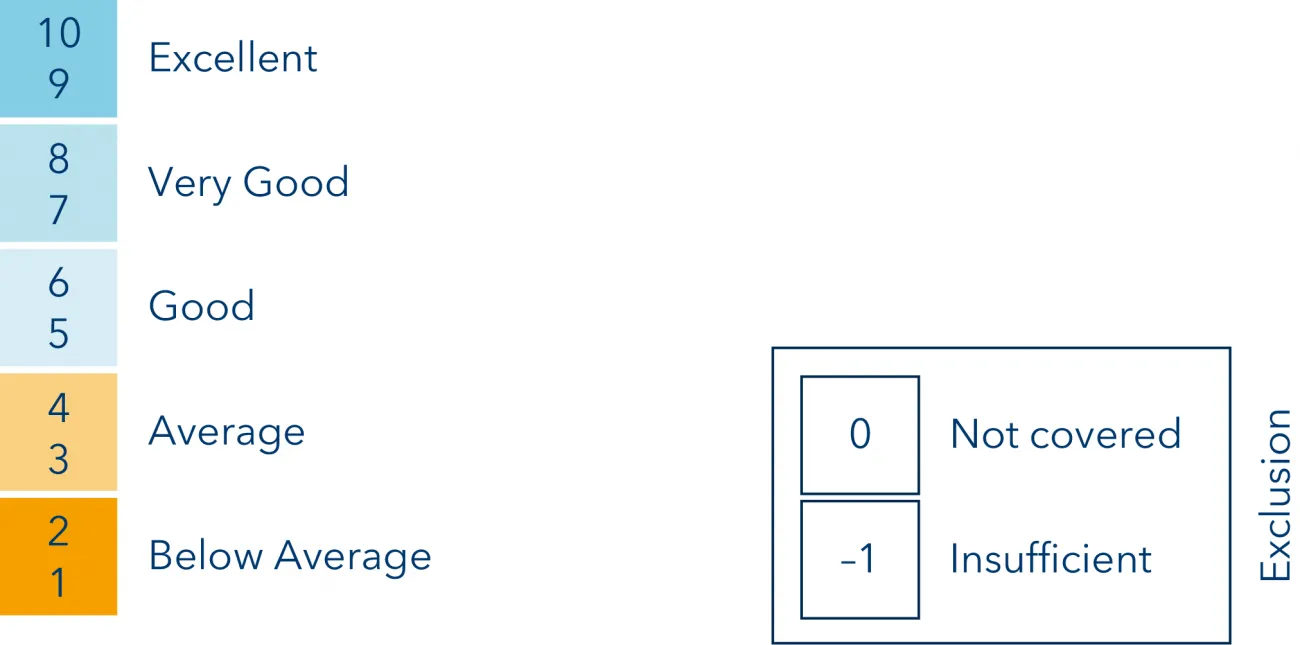
Whether on a security, on a portfolio or on a fund level, the sustainability assessment results in a sustainability score (as described above). The scale ranges from -1 to 10, where -1 is "insufficient", 0 is "not covered". Scores from 1 to 10 are divided into five buckets.
[1] available on a single title level only
Information on the extended disclosure requirements under Regulation (EU) 2024/3005
The following information relates to the VP Sustainability Score (VPSS) and complies with the disclosure requirements set out in Annex III to Regulation (EU) 2024/3005 on ESG rating activities. Further information from the underlying data provider MSCI ESG Research and its ESG rating methodology for the disclosures required under the EU Regulation on ESG scoring activities (Regulation (EU) 2024/3005) is available at: www.msci.com/legal/sustainability-and-climate-resources-and-disclosures
(within meaning of Annex III.1 para. f, i, o, p)
The primary objective of the VPSS is to systematically consider financially material ESG risks and opportunities in investment decisions (outside-in perspective). The VPSS also aims to reduce negative impacts through exclusions in cases of breaches of relevant international conventions and in relation to highly critical business activities, as described in section ‘3. Business Practices’ and ‘4. Business Activities’. Furthermore, positive impacts are to be promoted by awarding companies a bonus on their overall rating provided they make a positive contribution to one or more of the UN Sustainable Development Goals (SDGs). Further information on this can be found in section ‘5. SDG Score’. The VPSS does not explicitly consider the requirements and targets of the Paris Agreement, although individual components included in the ESG score are related to it.
| Focus | Basis | Motivation | Weight |
|---|---|---|---|
| Risk | ESG-Score | VP Bank reduces ESG risks in its portfolios by avoiding companies with very low ESG scores and favouring those with high scores. | 33% |
| Risk, Impact | Business practices | VP Bank avoids companies with business practices that are illegal or violate international standards. | 17% |
| Risk, Impact | Business activities | VP Bank has defined minimum ethical standards that determine the areas in which the companies in which we invest should not be active. | 17% |
| Opportunities | ESG momentum | VP Bank aims to finance the transition to a more sustainable future by investing in companies that demonstrate continuous improvement in their ESG performance. | 17% |
| Impact | Sustainable Development Goals (SDG) | VP Bank prioritises companies that have a positive impact on the environment and society by contributing to one or more of the Sustainable Development Goals (SDGs). | 17% |
(within meaning of Annex III.1 para. b, c, g, h, k)
The starting point for the VPSS is the aggregated MSCI ESG Score, which comprises 13 key themes in the environmental category, 14 in the social category and 6 in the governance category. The key themes do not correspond exactly to the standards for sustainability reporting developed in accordance with Article 29b of Directive 2013/34/EU. The weighting of the E, S and G factors, as well as the associated key themes, is determined by MSCI on a sector-specific basis and reflects financial materiality for GICS sub-sectors. MSCI data points are based on publicly available information. This may have been disclosed by companies in their sustainability statements prepared in accordance with Directive 2013/34/EU and Regulation (EU) 2019/2088, or it may be collected independently of these disclosures. In isolated cases, MSCI may use estimated or proxy values derived from industry averages, regional criteria and extrapolations. No artificial intelligence is used on behalf of VP Bank to calculate the VPSS. It is not known whether artificial intelligence is used by MSCI in the context of data collection and processing.
(within meaning of Annex III.1 para. a, e, j)
The VPSS comprises five sub-components, which are described in detail in sections 1–5. The VPSS methodology is based, amongst other things, on scientific findings such as those by Giese et al. (2019) [1] and Alessandrini & Jondeau (2020) [2]. The starting point for the VPSS is the aggregated MSCI ESG Score. Building on this, securities are awarded a premium or a discount in their valuation across the other four dimensions. The maximum premium is achieved in the event of a positive ESG change compared with the previous period (ESG momentum), impeccable business practices, no business activity in questionable sectors and a positive contribution to one or more UN Sustainable Development Goals. Securities subject to exclusion are those with an MSCI rating of CCC or B (so-called ‘laggards’), those that breach relevant international conventions or those active in ‘critical’ business sectors. Securities for which a VPSS cannot be calculated due to a lack of information are also excluded. The VPSS is a relative key operating indicator on a scale from –1 to +10, with securities excluded due to previous breaches receiving a value of ‘–1’ and unrated securities receiving a ‘0’. In principle, the information incorporated into the ESG score consists of descriptions of a company’s past ESG performance and is therefore retrospective in nature, with rating updates generally carried out every 12 to 18 months. The VPSS is calculated monthly for the entire universe and, consequently, adjustments to the ESG score are reflected in a timely manner. Forward-looking indicators, information from scenario analyses or transition pathways are not currently included in the VPSS.
[1] Giese, G., Lee, L.-E., Melas, D., Nagy, Z., & Nishikawa, L. (2019). Foundations of ESG investing: How ESG affects equity valuation, risk, and performance. Journal of Portfolio Management, 45(5), 69–83.
[2] Alessandrini, F., & Jondeau, E. (2020). ESG investing: From sin stocks to smart beta. Journal of Portfolio Management, 46(3), 75–94.
(i. S. v. Anh. III Nr. 1 lit. d, l, m, n, q)
To avoid conflicts of interest, the VPSS is developed and managed by the Investment Research and Sustainability departments. The operational side – that is, its use by portfolio management and investment consulting teams – is separate from this. The VPSS is based on a systematic, model-based approach, which is calculated centrally and fed into the bank’s internal system for further use. The VPSS is applied in portfolio management as a mandatory selection criterion. There are no cross-shareholdings between VP Bank and MSCI ESG Research that could give rise to conflicts of interest. The VPSS is not marketed as a standalone product and therefore does not incur any additional costs for our clients. Any limitations regarding the information available to us may result from methodological adjustments made by the data provider, which have direct influence on the VPSS. Furthermore, data quality can only be verified to a limited extent, meaning we must rely on the accuracy of the data points supplied. VP Bank does not carry out any additional systematic data validation. In addition, companies may go for extended periods without receiving updates. This can potentially lead to outdated data and sub-optimal investment decisions.
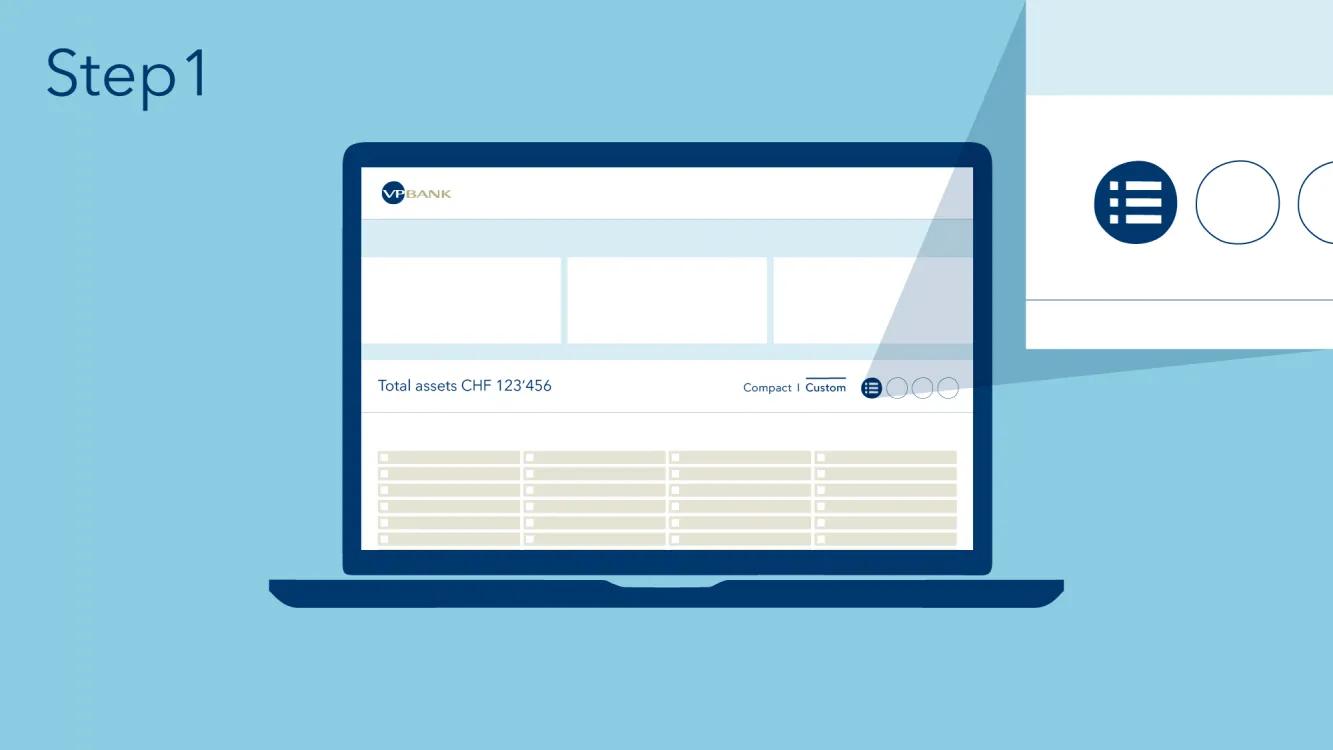
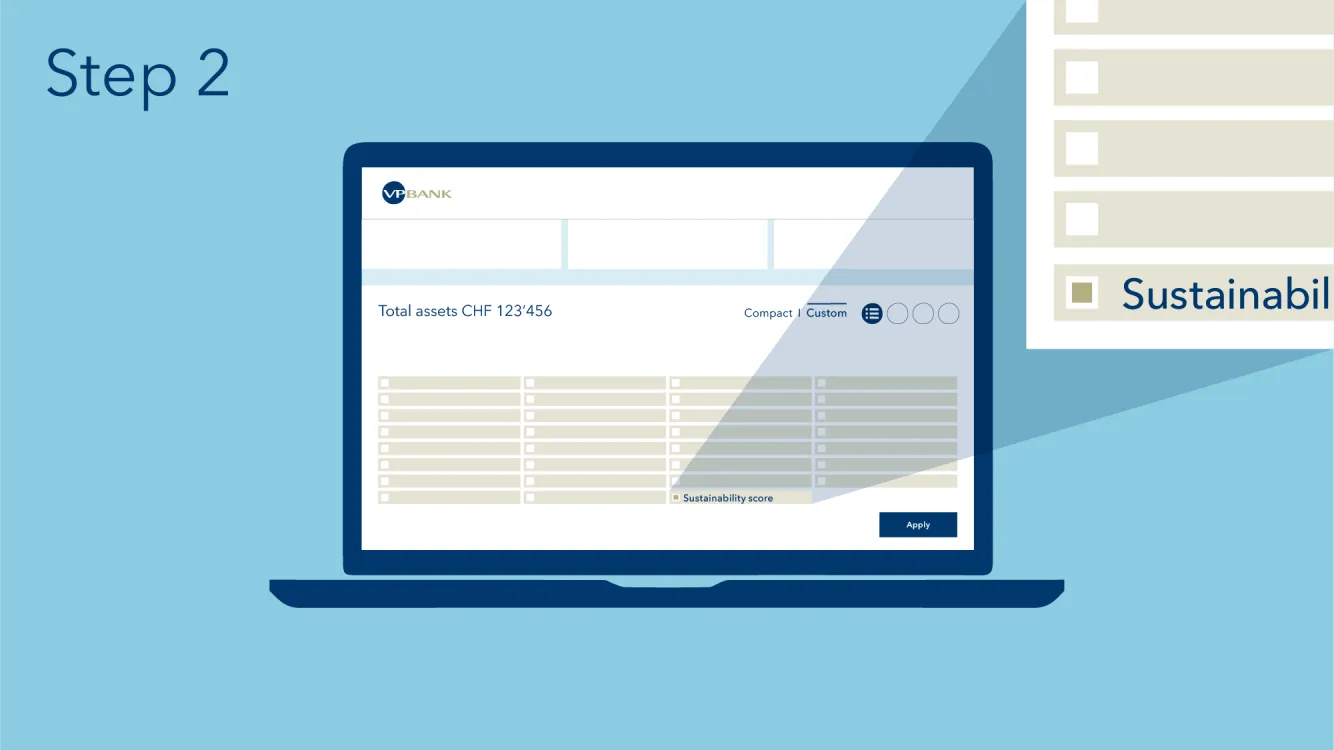
Activate the VP Bank Sustainability Score in your client portal